arm note book there is 3 profile of arm ship
Base of the ARCH
-
A: “application” → ex : phone, laptop, IOT
-
R: designed Ffor hard real-time or safety-critical systems → ex : medical, HDD controllers
-
M: microcontroller → ex : embedded, Bluetooth, GPS
-
arm v7 → aarch32
-
arm v8 → aarch64/aarch32
-
arm v9 → same as v8 but with Scalable Vector Extension v2 (SVE2), Transactional Memory Extension (TME), and Branch Record Buffer Extensions (BRBE).
aarch32 has two mode :
- A32 (BASE) all instr are 32 bit
- T32 (Thumb) instruction are manly 16 but have been able to use 32 bit instr
aarch64 compatible with arm A32 and T32
aarch64
only has A64 with 32bit instruction encoding but a backward compatibility with A32 and T32
Diff between arch and micro-arch
- architecture is the behavioral description of a processor and defines compo- nents like the instruction set
- micro-architecture defines how the processor is built. This includes the number and sizes of the caches, which features are imple- mented, the pipeline layout, and even how the memory system is implemented
LEVEL
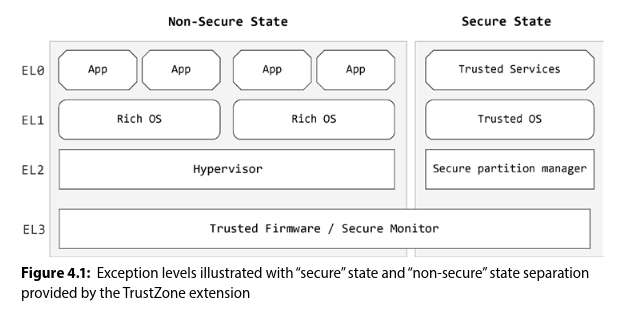
- EL0 random program
- EL1 kernel
- hypervisor (KVM)
- EL3 is used by processors with TrustZone to switch between secure and normal worlds through the Secure Monitor.
Trusted Zone
- Protects sensitive data and code even if the main OS is compromised.
- Needed for:
- OS integrity checks
- Fingerprint or credential management
- Device encryption keys
- Banking / DRM / secure messaging apps
- Separates trusted (secure) and untrusted (normal) execution to stop malware from accessing critical data.
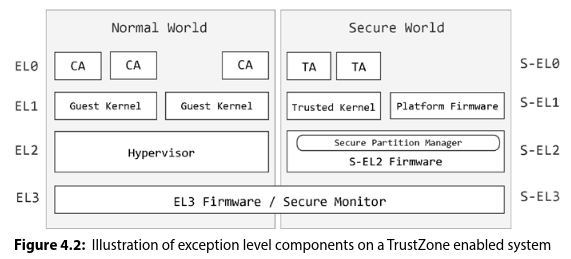
- S-EL0 Trusted apps (TAs) → user-level secure apps
- S-EL1 TEE OS → trusted kernel
- S-EL2 Trusted drivers (TDs) → secure hardware access
- S-EL3 Secure Monitor → world switching and full device access
Exeption Level
this is to call into the upper level of execution
vector base address register (VBAR) → store the addres of the base vector table
What happens during an exception
- CPU stops current execution.
- It jumps to a vector table in the higher EL using the
VBAR_ELnregister. - Runs the exception handler (OS or firmware code).
- When finished, it returns to the previous level with
eret
How they are trigger
Synchronous → caused by code (SVC/HVC/SMC)
- EL0 → SVC (supervisor call) → EL1 (OS)
- EL1 → HVC (hypervisor call) → EL2 (Hypervisor)
- EL2 → SMC (secure monitor call) → EL3 (Secure Monitor)
Asynchronous → caused externally IRQ (Interrupt Request)/FIQ (Fast Interrupt Request)
- EL0 → IRQ/FIQ (hardware interrupt) → EL1 (OS)
- EL1 → IRQ/FIQ (virtual or physical interrupt) → EL2 (Hypervisor)
- EL2 → IRQ/FIQ (secure interrupt) → EL3 (Secure Monitor)
Execution state
they exist to support both old 32-bit and new 64-bit programs on the same chip.
AARCH64 Register
overview
- X0–X30 → 64-bit general-purpose registers
- W0–W30 → lower 32 bits of X0–X30
- V0–V31 → 128-bit SIMD & floating-point registers
- XZR/WZR → zero register (always reads 0, discards writes)
- SP → stack pointer (separate copy per EL)
register roles
- X0–X7 → function arguments and return value
- X8 → indirect result pointer
- X9–X15 → caller-saved temporaries (saved by caller)
- X16–X18 → intra-procedure temporaries (for immediate values)
- X19–X28 → callee-saved registers (saved/restored by callee)
- X29 → frame pointer (FP)
- X30 → link register (LR, return address)
special register
- PC (Program Counter) → holds address of next instruction
- SP (Stack Pointer) → points to current stack frame
- FP (Frame Pointer) → links stack frames for backtrace
- LR (Link Register) → return address after BL (branch-and-link)
on aarch32 they are map to simple register
- FP → r11
- IP → r12
- SP → r13
- LR → r14
- PC → r15
PCisn’t directly addressable in AArch64 (unlike AArch32’sr15). You use PC-relative instructions likeADR/ADRPinstead.
System Registers
system flag that are accecyble only by the instruction mrs to read it and msr to write it
PSTATE → processor status flags (NZCV, interrupt masks, EL bits, etc.) VBAR_ELn → vector table address for each EL SPSR_ELn → saved program status on exception
PSTATE flags
- N –> Negative
- Z –> Zero
- C –> Carry
- V –> Overflow
zerso register (xzr/wzr)
with the register seting a register to zero the optimal way is now implicit not like in x86 with xor rax rax here you can mov x0 xzr
XZR lets A64 reuse existing instructions instead of defining new ones. Example:
cmp Xn, #11        → alias for
subs XZR, Xn, #11  → subtract & set flags, result discarded
on x86 you don’t have alias like that cmp uses different opcode, but identical micro-ops
Data processing instruction
the chapter 5 is pretty much self explanatory if i need a info i can just look at it directly so this is just a small resume of things i had a bad time remembering
Encoding
add x0, x0, x1 ; ADD (register)
add x0, x0, #100 ; ADD (immediate
add x0, x1, x1, LSL #1 ; ADD (shifted register)
Constant

Imm Encoding (A64)
- Immediate = 12-bit + optional << 12 shift → can encode 0–4095 or multiples of 4096.1
the sh bit is usefull for this like :
- page size
- region sizes
- memory barriers
- block sizes
- descriptor table offsets
add x5, x5, #4095 ; 4095 = 1111 1111 1111
add x5, x5, #4096 ; 4096 = 1 0000 0000 0000

after disass

add x5, x5, #4095 ; 4095 = 1111 1111 1111
add x5, x5, #1, lsl #12 ; 0000 0000 0001 << 12 = 4096
Shift inside instruction (ARM)
ARM ALU ops can include a shift on the operand because:
- Encoding includes a shift field inside the operand (not a separate instr).
- Hardware datapath is:
Rm → barrel shifter → ALU → Rd. - Shift = cheap (just wiring), so ALU+shift fits in one instruction.
- Reduces code size + avoids temp registers.
Flags
a lot of instruction exist with a version than end with s to set the flags
ex : add and adds
Bitfield instr
UBFM → zero-extend + extract
SBFM → sign-extend + extract
BFM  → insert bitfield
common alias
LSR = UBFM with specific parameters
ASR = SBFM with specific parameters
lea is just an add
x86 :
lea rax, [rbx + 32]
lea rax, [rbx + rcx*4]
lea rax, [rbx + rcx]
lea rdi, [rip + msg]
arm :
add x0, x1, #32
add x0, x1, x2, LSL #2
add x0, x1, x2
adr x0, msg (alias)→ add x0, pc, msg
instr with not obvious use case
RRX
(w = (carry << 31) | (w >> 1))   ; rotate right through carry
carry_out = old bit0- Carry comes from previous
…Sinstruction. - Used for multi-word right shifts/rotates (64-bit, 128-bit, crypto, bigint).
UMAAL
(low, high = a * b + low + high)
- 64-bit multiply-accumulate.
- Used in checksum, hash, crypto, MAC loops, bigint multiply.