Frontend

graph TD
  subgr[]()aph Phase1_The_Map_Cache
    A["Current PC (Instruction Pointer)"] --> B{"BTB (Branch Target Buffer)<br/>Have we been here before?"}
    B -->|Hit| B1["Predict exact target address instantly"]
    B -->|Miss| B2["Guess we just go to the next line"]
  end

  subgraph Phase2_The_Raw_Material_Cache
    B1 --> C{"L1 Instruction Cache (32KB)<br/>Are the raw bytes stored locally?"}
    B2 --> C
    C -->|Hit| D["Fetch bytes instantly at 32 bytes/cycle"]
    C -->|Miss| D_Miss["STALL: Wait for slow L2/L3 Cache or RAM"]
    D_Miss -.-> D
    D --> E["Pre-decode identifies instruction length"]
    E --> F["Instruction Queue"]
  end

  subgraph Phase3_The_Effort_Cache
    F --> G{"µop Cache (4k entries)<br/>Did we already decode this recently?"}
    G -->|Hit: The Fast Path| I["BYPASS DECODERS!<br/>Deliver 8 pre-built µops/cycle"]
    G -->|Miss: The Slow Path| J["6-way Decoder powers up<br/>Translates complex x86 to µops (6/cycle)"]
  end

  subgraph Phase4_Execution_Prep
    J --> U1["µop 1: Calc Address"]
    J --> U2["µop 2: Load Data"]
    J --> U3["µop 3: Add Math"]

    U1 --> Q["Instruction Decode Queue (144 µops)<br/>Buffer to keep Backend fed"]
    U2 --> Q
    U3 --> Q

    I -->|Direct Injection| Q
  end

  subgraph Phase5_Backend
    Q --> R["Rename & Allocate"]
    R --> S["Out-of-Order Execution Engine"]
  end

  %% Styling
  style B fill:#f9d0c4,stroke:#333,color:#000000
  style C fill:#f9d0c4,stroke:#333,color:#000000
  style G fill:#c4e1f9,stroke:#333,stroke-width:2px,color:#000000
  style I fill:#d4f9c4,stroke:#333,color:#000000
  style D_Miss fill:#f9c4c4,stroke:#333,stroke-dasharray: 5 5,color:#000000
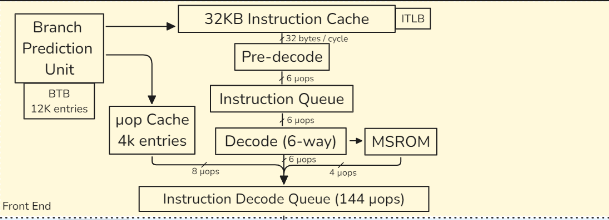
This graph is missing the MSROM and predecode link with the BPU, but I can’t get this to render properly.
Branch Prediction Unit (BPU)
- Predicts next fetch address
- Uses BTB (12K entries):
- branch PCs
- target addresses
- Runs every cycle
- Drives instruction fetch
- Mispredict → pipeline flush (handled via MSROM)
Instruction Fetch
- L1 I-cache:
- 32 KB
- fetches 32 bytes / cycle
- SMT:
- threads alternate → 32B every other cycle
- Fetch address from BPU
Pre-decode
- Finds instruction boundaries (x86 = variable length, 1–15B)
- Detects branches
- Emits up to 6 macro-instructions / cycle
Instruction Queue
- Buffers macro-instructions
- Shared between SMT threads
- Performs macro-op fusion
- two macros → one µop
- saves backend bandwidth
Decode
- 6-way decoder
- Converts macro-ops → fixed-length µops
- Output goes to IDQ
µop Cache (DSB)
- Caches decoded µops
- Checked in parallel with I-cache
- Capacity:
- ~4K entries
- 8 µops / cycle
- Avoids:
- pre-decode
- decode
- Major frontend performance win
MSROM (Microcode Sequencer / Microcode ROM)
MSROM is the microcode execution engine inside the CPU.
It is entered when an instruction or event is too complex, too rare, or too sensitive
to be handled entirely by hardwired logic.
Its primary goal is correctness and recoverability, not performance.
What triggers MSROM
-
Complex x86 instructions
REP MOVSB,REP STOSB(memcpy(dst, src, n))ENTER,BOUND(function prologue / bounds check)- Atomic / system ops (
lock cmpxchg)
-
Assists (exceptional events)
- TLB miss (
first access to mapped page) - Page fault (
PTE invalid → #PF to OS) - Branch misprediction recovery
- Machine clears (
self-modifying code) - Floating-point denormals (
1e-310 * 2.0)
- TLB miss (
-
Security & compatibility handling
- Speculation mitigations (
lfence after bounds check) - Post-silicon microcode updates (
Spectre fix)
- Speculation mitigations (
How MSROM works
When entered, MSROM:
- Temporarily takes control of the frontend
- Executes a microcode routine
- Emits µops directly into the backend
- Restores architectural state and resumes normal execution
Throughput is limited (typically ≤ 4 µops / cycle)/
Instruction Decode Queue (IDQ)
- Boundary between in-order frontend and OOO backend
- Capacity:
- 144 µops (single thread)
- 72 µops per SMT thread
Out-of-order execution
 lets the CPU execute instructions as soon as their data is ready, not strictly in program order, to keep hardware busy and increase performance.
Reorder Buffer (ROB)
- 512 entries
- Core responsibilities:
- register renaming
- resource allocation
- speculative tracking
- in-order retirement
- Allocate:
- 6 µops / cycle
- Retire:
- 8 µops / cycle
Register Renaming
- Architectural regs → physical regs
- Structures:
- RAT (Register Alias Table)
- PRF (Physical Register File)
- Separate PRFs:
- INT
- FP / SIMD
Zero-latency idioms (Frontend / Rename-time)
- Zeroing idioms (
xor eax,eax) - Move elimination
- NOPs
- Some arithmetic bypasses
→ save execution resources
Scheduler / Reservation Station (RS)
- Tracks:
- operand readiness
- execution port availability
- Dispatch:
- 6 µops / cycle
- Smaller than ROB (~200 entries measured)
Backend
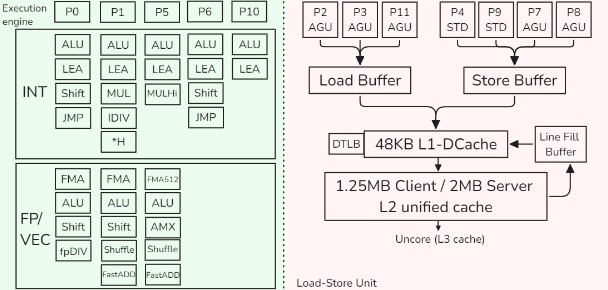
Execution Engine
INT / FP / Vector
- Ports: 0, 1, 5, 6, 10
- ALU, LEA, shifts, MUL, FP, SIMD
- INT and FP/VEC use separate PRFs
Address Generation (AGU)
- Ports: 2, 3, 7, 8, 11
- Required for all loads and stores
Stores
- Ports: 4, 9
- STD = store data
Port pressure matters
- Some ops are port-restricted
- Example:
- FP divide → port 0 only
- Conflicts → dispatch stalls
Load-Store Unit (LSU)
Load capabilities
- Up to:
- 3 loads / cycle
- (3×256-bit or 2×512-bit)
- Requires AGU
Store capabilities
- Up to:
- 2 stores / cycle
- (2×256-bit or 1×512-bit)
Load / Store Buffers
- Load Buffer (Load Queue)
- Store Buffer (Store Queue)
- Track in-flight memory ops
- Enable:
- store-to-load forwarding
- memory reordering
L1 Data Cache access
- 48 KB L1 D-cache
- Load path:
- cache lookup + TLB lookup in parallel
- L1 hit → value forwarded
Miss handling
- L1 miss:
- check L2
- allocate Fill Buffer (FB)
- 16 fill buffers
- Speculative L3 lookup in parallel
- Same-line loads share FB (“glued” loads)
Store optimizations
- Write-allocate (default)
- Store combining
- Streaming stores (no read-for-ownership)
- Non-temporal stores:
- bypass cache pollution
Memory ordering
- Weakly ordered
- Loads can bypass:
- older loads
- some older stores
- Memory disambiguation predicts dependencies
- Mis-prediction → pipeline flush (very expensive)
TLB Hierarchy (Golden Cove)
L1 TLB
- ITLB:
- 256 entries (4K pages → 1 MB reach)
- DTLB:
- 96 entries (4K pages → 384 KB reach)
L2 TLB (STLB)
- 2048 entries
- Shared I + D
- ~8 MB reach (4K pages)
Page walk acceleration
- Hardware page walkers:
- 4 concurrent walkers
- Paging-Structure Caches:
- cache upper page-table levels
- reduce loads during page walk
- Page walk loads use normal cache hierarchy
SMT resource sharing
- Shared:
- caches
- TLBs
- execution units
- Partitioned / replicated:
- IDQ
- ROB
- RAT
- RS
- Load / Store Buffers
- PRF